
The SQA2 Blog: General
Why testability matters
A requirement that cannot be tested usually cannot be built correctly either. If nobody can say how a requirement will be verified, nobody can say when it is done. So during the definition phase, QA reads each requirement and design decision and asks one question: how will we verify this?
The question works because it forces specifics. Words like “accurate,” “timely,” “as needed,” and “user-friendly” cannot be tested. A count, a list of fields, a time limit, a named approver, and a defined failure behavior can.
Here is what that looks like on an EHR upgrade. These examples are illustrative, not taken from any one project.
| Area | As first written | After QA review |
| Data migration | Patient allergies migrate accurately. | Every active allergy migrates with its allergen, reaction, severity, and status. A reconciliation report compares counts by type between the old and new systems, and pharmacy reviews any mismatch before cutover. |
| Interfaces | Lab interfaces handle errors gracefully. | An inbound lab result that fails validation is held in a queue, the integration team is alerted within an agreed time, and no result is dropped. Tests cover a missing patient identifier, an unknown order number, and invalid units. |
| Clinical content | Updated order sets are approved before go-live. | Each changed order set has a named clinical owner, and the pharmacy and therapeutics committee signs off on medication content. Approval is recorded before that build is marked done. |
| Performance | The system performs well at peak times. | Opening a chart and entering an order finish within agreed times at peak concurrent users, measured in a production-like environment. |
Each rewrite takes minutes. It also gives the build team a clear target and gives QA a test it can write now, before anything is built.
The gaps QA tends to find
The same kinds of gaps show up on most EHR upgrades. None of them is exotic. Each is easy to miss when the team is focused on what the system should do, and easy to see when someone is focused on how it will be checked.
- Data reconciliation. Which clinical data must match after migration, by what measure, and who decides whether a mismatch blocks go-live. Allergies, medications, problem lists, and open orders usually need the strictest standard.
- Interface failure behavior. What happens when a message fails, arrives incomplete, arrives twice, or arrives out of order. Requirements often describe the successful message and nothing else.
- Sign-off on clinical content. Who approves changed order sets, alerts, and documentation templates, and by when. Without a named approver, these changes stall in testing.
- Workflows assumed to be unchanged. Which workflows are in scope for testing and which are assumed to be unaffected. The vendor’s release notes often show that an “unchanged” screen, default, or rule did change.
- Roles and access. Which user roles see which screens, orders, and records. A requirement written for “users” hides real differences between a nurse, a physician, and a billing clerk.
- Downstream reports and feeds. Quality measures, billing exports, registry submissions, and data warehouse feeds that depend on fields the upgrade touches. These rarely appear in the requirements unless someone asks.
- Downtime and rollback. What staff do if the system is unavailable during cutover, and what conditions trigger a rollback. These need requirements too, because they need tests.
How a QA requirements review works
A requirements review is not a long audit at the end of definition. It runs alongside the analysts’ work, in batches, as requirements are drafted.
A QA engineer leads the review from start to finish. AI is part of how the engineer works, not a separate step that runs on its own. For each requirement, the engineer:
- Uses AI to raise gaps, undefined terms, and clarifying questions, then reads each one. The engineer keeps or sharpens what matters, discards what doesn’t, and adds what the AI missed.
- Confirms the requirement can be verified, and names how: a test, a data comparison, an inspection, or a demonstration.
- Adds what takes knowledge of the project, such as dependencies on other teams, interface partners, or changes in the vendor’s release notes.
- Sends each clarifying question to the person who can answer it, and checks the answer when it comes back.
- Logs each finding with an owner and a due date.
Take the allergy requirement in the table above. AI can flag “accurately” as undefined, note that no reconciliation method is named, and draft a question about which allergy statuses must migrate. The QA engineer confirms those findings, adds that pharmacy should review any mismatch, and sends the question to the right clinical owner.
AI accelerates execution, not judgment. It helps the engineer apply the same checks to every requirement, so nothing gets a lighter read because the batch was long or the deadline was close.
AI does not make decisions in this process. Every finding that reaches the log has been read and confirmed by a person.
The review produces three things. A findings log lists each gap, its owner, and how it was resolved. Every requirement has a verification method attached. And the first draft of the traceability matrix links each requirement to the tests that will prove it, which part 3 of this series covers in detail.
The people who wrote the requirements stay in charge of them. QA’s job is to make each one checkable, not to decide what the system should do. Clinical informatics and the business owners resolve the findings, and QA confirms the result can be tested.
What a gap costs at each stage
Fixing a gap during definition usually means rewording a requirement. Finding the same gap during user acceptance testing can mean rework, retesting, and a new go-live date. The gap is the same in both cases; the difference is how much has been built on top of it.
On an EHR upgrade, a lot gets built on top of a requirement: configuration, interface mappings, order set builds, test scripts, training materials, and the cutover plan. A late change can touch all of them, and every piece it touches needs retesting.
The research points the same way:
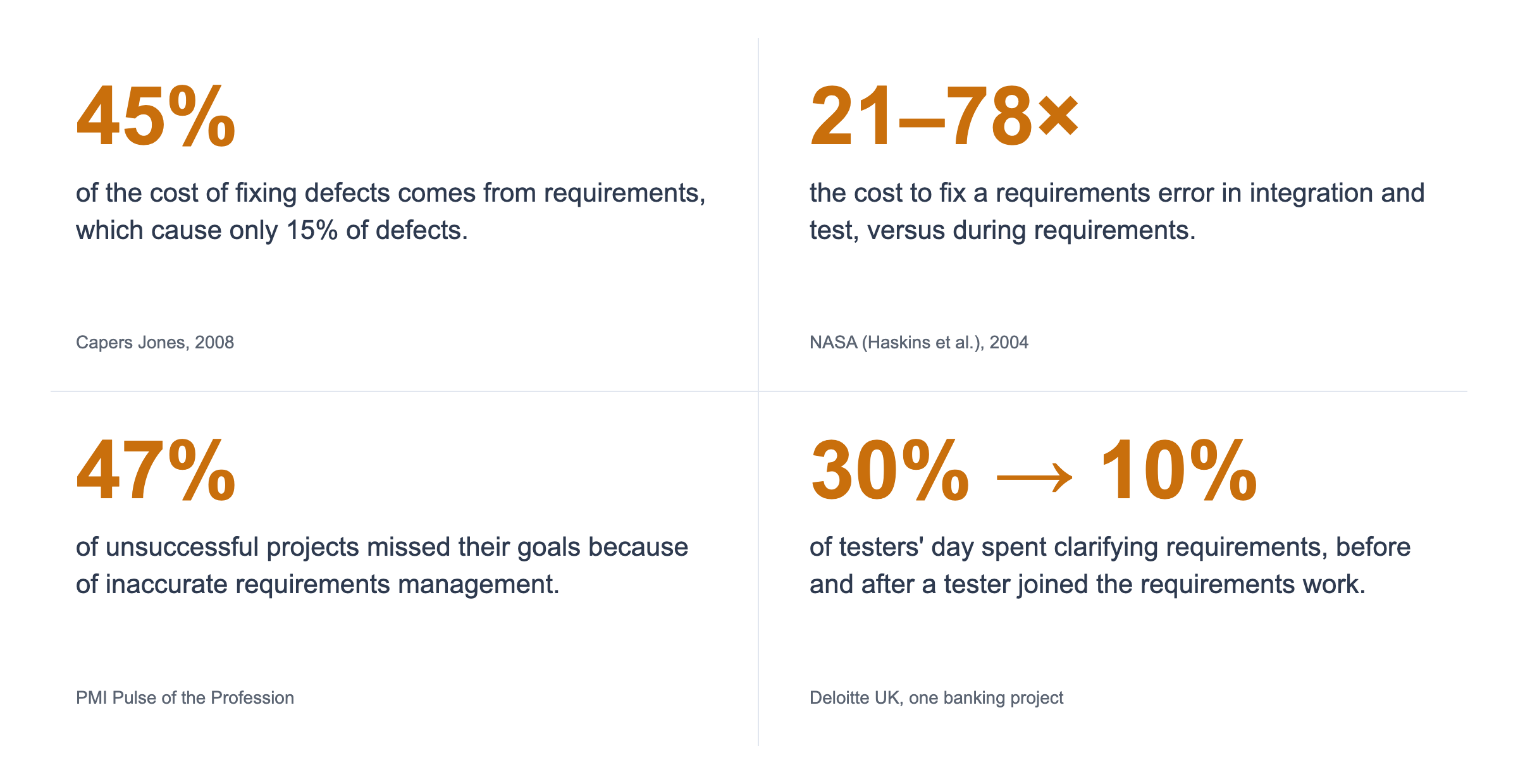
These studies are older or single-project, the multipliers vary from study to study, and none is specific to EHR projects. They still agree on the direction: the later a requirements gap is found, the more it costs.
The ask for leaders
Before the build starts, ask your project team three questions:
- Has QA reviewed the requirements? If the answer is no, the schedule carries risk that nobody has measured yet.
- What did QA find, by category? A review that found almost nothing was usually too light. Requirements are rarely that clean.
- How was each finding resolved, and who decided? Findings with no owner are the ones that come back in testing.
The conversation takes minutes and tells you a lot about the state of the project. Three answers deserve a follow-up question:
- “QA will pick that up in testing.” By then, the gap has configuration, interfaces, and scripts built on top of it.
- “The vendor tests the upgrade.” A vendor tests its release. It does not test your build, your interfaces, or how your staff work.
- “Those workflows aren’t changing.” Ask who confirmed that, and against which release notes.
PMI’s research named sponsor support as one of three factors that separate strong requirements work from weak. Asking these questions is what that support looks like in practice.
If your team does not have QA capacity for this review, an outside QA team can join the project in days and start with the requirements. Part 3 of this series covers what comes next: the traceability matrix and evidence standard to expect from QA before testing begins.
This is a part of our overall EHR Upgrade Planning series.
Sources
All pages were opened on November 12, 2026.
- PMI, Requirements Management: A Core Competency for Project and Program Success (Pulse of the Profession, The High Cost of Low Performance 2013 series)
- ReworkCost.com, The Canonical Rework Studies, summarizing Capers Jones, Applied Software Measurement, 3rd ed. (2008)
- Deloitte UK, Your Bad Requirements Are Costing You Money (January 2022), which cites Haskins et al., Error Cost Escalation Through the Project Life Cycle (NASA, 2004)