
Performance Testing
Can your application handle the traffic you expect at launch?
Your application may work well during functional testing, but how will it perform when thousands of users access it at the same time? Whether you’re launching a new platform, migrating customers, preparing for a major sale, or approaching a filing deadline, you need to understand what your system can handle.
Many organizations begin performance testing without defined SLAs, an understanding of their current API capacity, or reliable test scripts. These issues can delay testing and make it difficult for leadership to assess launch readiness.
The resources below can help you evaluate your current performance testing efforts, establish load targets, and understand how SQA² approaches performance testing.
Performance Testing Tools
How ready is your performance testing?
Our performance testing scorecard takes approximately three minutes to complete. It includes seven questions covering SLAs, system capacity, load targets, test environments, and testing methodology. Your results will help you identify gaps in your current performance testing efforts.
Take the scorecard
How much load should you test for?
Enter your expected number of users, peak traffic window, and the actions your users typically perform. The calculator determines the requests per second each action needs to support, along with a recommended load target for the full user journey. Each result includes a breakdown of how it was calculated.
Calculate your load targets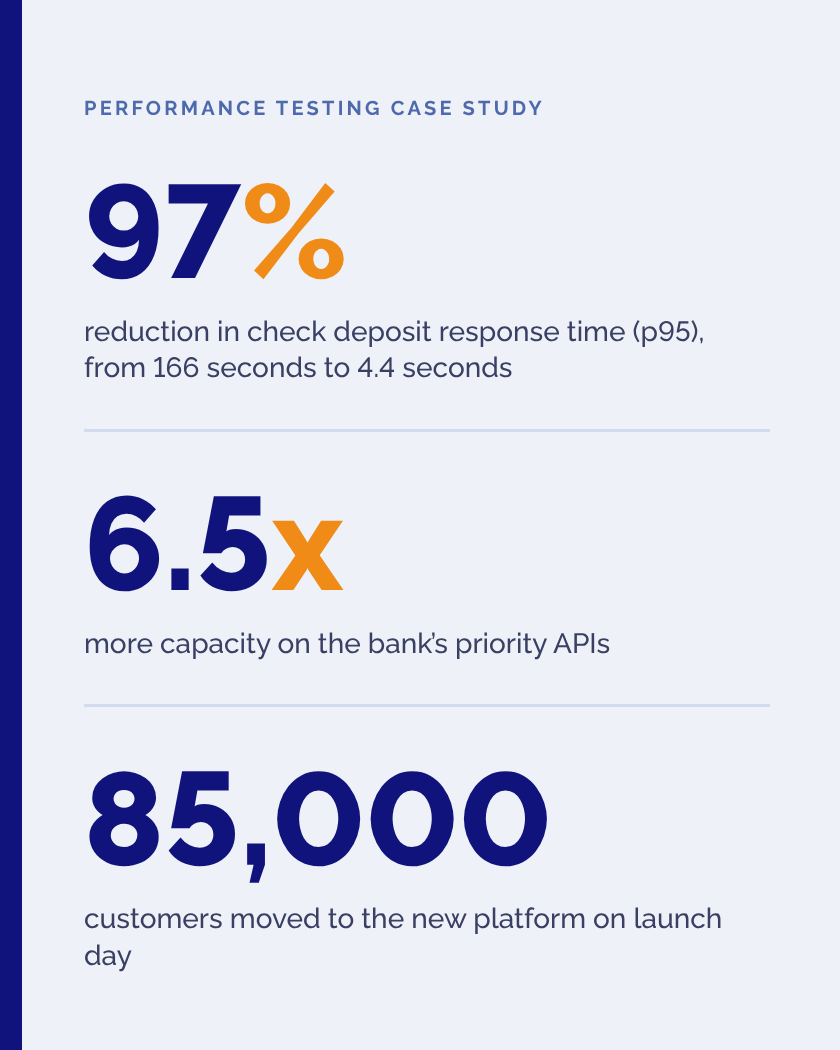
Meeting every API performance SLA before a platform launch to 85,000 customers
One of the largest private banks in the US was preparing to migrate its customers to a new online banking platform. After a year of internal performance testing efforts, the bank still did not have the results it needed to determine whether the platform was ready for launch.
With approximately six months remaining, SQA² took over the performance testing effort, established API capacity baselines, and worked with the bank’s development teams to identify and resolve performance bottlenecks.
Every API met its performance SLA before launch. The bank also retained the test scripts, SLAs, and historical test results for ongoing performance testing.
Download the case study (PDF)SQA²’s Performance Testing Methodology
SQA² uses six testing cycles to evaluate different aspects of system performance. Each cycle serves a specific purpose, from validating the test configuration to determining system capacity, identifying bottlenecks, and verifying recovery after a sudden increase in traffic.
| Cycle | Purpose |
|---|---|
| A. Baseline | Validate the test configuration, environment, APIs, and test data. |
| B. Steady state | Determine the load at which performance begins to degrade. |
| C. Capacity | Verify that the system can sustain its maximum stable load. |
| D. Stress | Identify where and how the system fails under excessive load. |
| E. Soak | Identify performance issues that develop under prolonged load. |
| F. Spike and recovery | Evaluate how the system handles sudden traffic increases and recovers afterward. |
We begin by testing individual APIs before moving on to day-in-the-life scenarios that simulate how customers use the application. This allows us to identify and address individual API bottlenecks before evaluating how those APIs perform together.
In our banking engagement, performance bottlenecks initially limited the full customer journey to 3.42 requests per second. After the individual API issues were resolved, the same scenario reached 41.92 requests per second.
We recommend using an isolated performance testing environment whenever possible. When one is unavailable, we assess the differences between the available environment and production and account for those differences when evaluating the results.
Read the full methodologyPerformance Testing Resources
Your customer journey is only as fast as your slowest API
Testing an entire customer journey without first understanding the performance of its individual APIs can make it difficult to isolate bottlenecks. This article explains why we test individual APIs first, using an example from our banking engagement where throughput increased from 3.42 to 41.92 requests per second.
Coming soon
No SLAs? Measure your capacity first
How to establish performance SLAs by measuring current API capacity and comparing the results with actual production traffic.
Coming soon
Performance testing without an isolated environment
How to account for differences between test and production environments, and why representative test data is important in preventing cached responses from skewing performance results.
Coming soonPreparing for an Upcoming Launch
If you’re planning to launch a new application or migrate an existing platform, we recommend starting with the following:
- Identify the features that require performance testing and prioritize those your customers use most.
- Review existing production traffic data to establish realistic load targets for each API.
- If production data is unavailable, establish a performance baseline for each API. Use those results to work with your development and product teams to define appropriate performance targets.
Talk to Us About Your Performance Testing
If you’re preparing for a launch or looking to improve your existing performance testing efforts, we’d be happy to learn more about your project and discuss how we can help.
We offer an initial 30-minute discussion to understand your requirements, concerns, and current testing efforts. New engagements can also start with a 90-day risk-free trial.